How to Solve a Murder…and Come Out Alive by Catherine Townsend
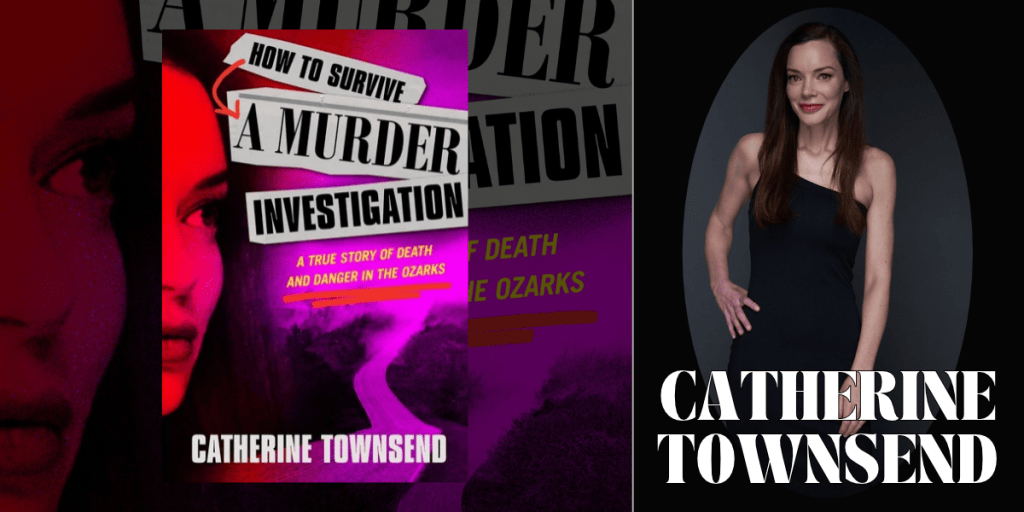
Ever imagined yourself as the detective in a crime novel, following a suspicious stranger down a dark alley? As an investigative journalist and licensed private investigator, I live this life for real. For How To Survive A Murder Investigation, I went back to the Ozarks to try to solve the cold case murder of 22-year-old college student Rebekah Gould. And I can tell you that whether I’m trying to bust a cheater outside a cheap motel or catch a killer who terrorized the Ozarks, the reality of stakeouts is darker, more dramatic and less glam than fiction.
Rule number one: Stakeouts require stamina.
Whether I’m holed up in a five-star hotel with a telescopic lens or driving through the woods on bald tires, no gas and no cell reception, surveillance is mind-numbingly boring–until it’s not. An investigator has to have the patience to sit through hours hunched over in a car or standing on a rainy corner, trying to remain invisible, until “The Subject” appears–and the shit hits the fan.
Rule number two: Following people is way harder than it looks on TV.
Sometimes you lose people, they roar onto an LA freeway offramp, or duck into the NYC subway. Sometimes, you even follow the wrong subject in a sea of people. In the Ozarks, I had the opposite problem – I had to blend into, and gain trust from, people who lived in a remote environment where outsiders were often seen as a threat. My secret weapons in these cases were kindness, persistence–and Winston, my senior six-pound chihuahua, who made trespassing on potentially private property look like a potty break.
Rule Number three: Trash is treasure.
Even in a digital era, the items that a person discards are a window into their soul. After verifying that my off-the-books trash collection was legal (which varies by jurisdiction, always check the laws first!) I learned to wear latex gloves, use Vicks VapoRub to disguise the smell of rotting food, and swap out cans on collection day. “Trash” was also, sometimes, the paperwork in cold cases – long dead leads scrawled onto pieces of paper that I assembled into my murder board.
Rule number four: Be obsessive.
Surveillance is a form of legal stalking. You need to have the passion and obsession of an actual stalker, with evidence that is cleanly noted in a case file, and used for good, and legal, purposes – while always being kind, respectful and on the right side of the law, even when others aren’t.
Rule number five: Pound the pavement.
I talk a lot in How To Survive A Murder Investigation about how digital technology has come a long way, and yet, so many cold cases require surveillance that online searches and AI just can’t provide. In Rebekah’s case, I spent years doing the type of old-school, gumshoe, on-the-ground reporting that is increasingly rare in an era when it’s possible to produce an entire true-crime story without ever leaving your desk. I knocked on a lot of strange doors – and I didn’t know whether the people I was interviewing were trying to help me, or whether they could be connected with the killer.
Rule number six: Whether it’s sex, drugs, violence or revenge, when the dramatic moment arrives, you only get one chance to capture evidence.
You must have your gas tank filled, battery charged, and camera focused for the moment someone answers the door in their underwear, and audio rolling to catch whispered confessions.
Which brings me to rule number seven: Make a backup bathroom plan.
According to the unwritten laws of surveillance, the aforementioned dramatic moment can and will arrive at the same moment that you are begging to use the bathroom in the back of a bodega or crouching beside a tree. Which is why it’s always a good idea to have a partner – ideally, one who can watch my back – or use an empty water bottle – in crucial moments.
But that was almost never possible while I was working on How To Survive A Murder Investigation. In that case, I largely worked alone.
Which brings me to my final rule: To remember that there was no handsome stranger coming to save me. In How to Survive a Murder Investigation, I realized that sometimes, the people–mostly men–in positions of power followed their own rules – rules that meant that Rebekah’s case continued to sit on a dusty shelf. If I wanted to help get justice for Rebekah and other cold case victims, I had to decide when to break them.
Discover the Author
What does it really take to solve a murder . . . and come out alive?
In 2004, Catherine Townsend was working as a journalist in London when college student Rebekah Gould vanished near Townsend’s childhood Ozarks retreat. Rebekah’s body was found a week later, leaving behind a blood-soaked trailer, a devastated family, and rumors that refused to die. To local police, Rebekah was just another “high-risk victim” who dated a lot of men and made a lot of women jealous. As time passed, the investigation stalled.
Thirteen years later, Townsend left her home base in New York for Arkansas, determined to crack the cold case, force the police to finally pay attention, and reckon with the place that had made her. In the process, she discovered that the truth about cold case investigations is a long way from what we see on TV–and that the roles people play in a murder case are rarely as simple as they seem.
As an investigative journalist, Townsend has faced danger from the potential murder suspects she’s trying to hunt down–and resistance from police who tell her that “investigations are grownup stuff” and to mind her own business. With How to Survive a Murder Investigation, she calls them all out as she recounts the audacious true story of her relentless search for the truth.