Beyond Blood: 10 Stories of Family and Belonging

Through the voices of underrepresented authors, this booklist explores the bonds that shape us, the histories we inherit, and the challenges of navigating family relationships across generations and cultures.
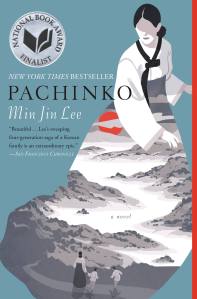
In this New York Times bestseller, four generations of a poor Korean immigrant family fight to control their destiny in 20th-century Japan.
“Stunning.” —New York Times Book Review
In the early 1900s, teenaged Sunja, the adored daughter of a crippled fisherman, falls for a wealthy stranger. When she discovers she is pregnant—and that her lover is married—she accepts an offer of marriage from a gentle, sickly minister passing through on his way to Japan. But her decision to abandon her home, and to reject her son’s powerful father, sets off a dramatic saga that will echo down through the generations.
Profoundly moving, Pachinko is a story of love, sacrifice, ambition, and loyalty.
NEW YORK TIMES BESTSELLER • #1 BOSTON GLOBE BESTSELLER • USA TODAY BESTSELLER • WALL STREET JOURNAL BESTSELLER • WASHINGTON POST BESTSELLER
Includes a reading group guide!
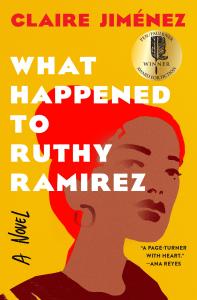
A powerful novel that’s “hilarious, heartbreaking, and ass-kicking” (Jamie Ford) about a Puerto Rican family in Staten Island who discovers their long‑missing sister is potentially alive and cast on a reality TV show, and sets out to bring her home.
Winner of the 2024 PEN/Faulkner Award for Fiction · Longlisted for the Aspen Words Literary Prize · March Indie Next Pick · Belletrist, Phenomenal, Page & Pairing, and Readers Digest book club pick
The Ramirez women of Staten Island orbit around absence. When thirteen‑year‑old middle child Ruthy disappeared after track practice without a trace, it left the family scarred and scrambling. One night, twelve years later, oldest sister Jessica spots a woman on her TV screen in Catfight, a raunchy reality show. She rushes to tell her younger sister, Nina: This woman’s hair is dyed red, and she calls herself Ruby, but the beauty mark under her left eye is instantly recognizable. Could it be Ruthy, after all this time?
The years since Ruthy’s disappearance haven’t been easy on the Ramirez family. It’s 2008, and their mother, Dolores, still struggles with the loss, Jessica juggles a newborn baby with her hospital job, and Nina, after four successful years at college, has returned home to medical school rejections and is forced to work in the mall folding tiny bedazzled thongs at the lingerie store.
After seeing maybe‑Ruthy on their screen, Jessica and Nina hatch a plan to drive to where the show is filmed in search of their long‑lost sister. When Dolores catches wind of their scheme, she insists on joining, along with her pot-stirring holy roller best friend, Irene. What follows is a family road trip and reckoning that will force the Ramirez women to finally face the past and look toward a future—with or without Ruthy in it.
What Happened to Ruthy Ramirez is a vivid family portrait, in all its shattered reality, exploring the familial bonds between women and cycles of generational violence, colonialism, race, and silence, replete with snark, resentment, tenderness, and, of course, love.
A Most Anticipated Book of 2023 by Elle • USA Today • Today.com • Ms. Magazine • Good Housekeeping • Bustle • The Week • Goodreads • Bookriot • Pop Culturely • SheReads • Litreactor • Electric Lit • The Mary Sue • People Español • Zibby Mag • Debutiful • Her Campus
Best Books of March by Shondaland • Ms. Magazine • Popsugar • Bookriot • Debutiful • Powell’s Book Blog • TIME 100 must-read book of 2023 • Booklist Top 10 debut of 2023 • Library Journal Best Pop Fiction of 2023 • The Latinidad List Best Debut Novel of 2023 • Chicago Public Library Favorite Book of 2023 • Good Housekeeping Must-Read Book of 2023 • Today.com Standout Book of 2023
Includes a Reading Group Guide.
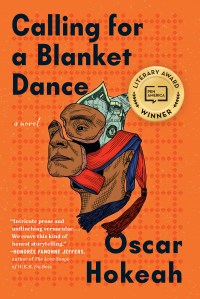
Winner of the PEN America/Hemingway Award for Debut Novel * Finalist for the 2023 Aspen Words Literary Prize * Finalist for the L.A. Times Book Prize/Art Seidenbaum Award for First Fiction
“A profound reflection on the intergenerational nature of cultural trauma… Hokeah’s characters exist at the intersection of Kiowa, Cherokee and Mexican identity, which provides a vital exploration of indigeneity in contemporary American letters.” —The New York Times Book Review
A moving and deeply engaging novel about a young Native American man as he learns to find strength in his familial identity.
Oscar Hokeah’s electric debut takes us into the life of Ever Geimausaddle, whose family—part Mexican, part Native American—is determined to hold onto their community despite obstacles everywhere they turn. Ever’s father is injured at the hands of corrupt police on the border when he goes to visit family in Mexico, while his mother struggles both to keep her job and care for her husband. And young Ever is lost and angry at all that he doesn’t understand, at this world that seems to undermine his sense of safety. Ever’s relatives all have ideas about who he is and who he should be. His Cherokee grandmother, knowing the importance of proximity, urges the family to move across Oklahoma to be near her, while his grandfather, watching their traditions slip away, tries to reunite Ever with his heritage through traditional gourd dances. Through it all, every relative wants the same: to remind Ever of the rich and supportive communities that surround him, there to hold him tight, and for Ever to learn to take the strength given to him to save not only himself but also the next generation.
How will this young man visualize a place for himself when the world hasn’t made room for him to start with? Honest, heartbreaking, and ultimately uplifting, Calling for a Blanket Dance is the story of how Ever Geimausaddle finds his way home.
“STUNNING.” —Susan Power, author of The Grass Dancer
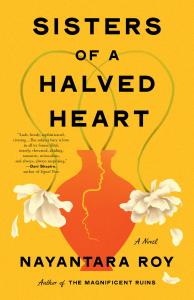
Mira Guhathakurta is a poetry editor at a distinguished literary magazine in New York, a dream job that has given her nearly everything she’s always wanted. And then she reconnects with Jack from college—kind, funny, intelligent Jack—and suddenly Mira feels as if she might have found her soulmate. They’ve woven their lives together so thoroughly; all that remains is for Jack to meet her family: her beloved father and dear sister Joy. But when Joy commits an unthinkable act of betrayal, the sisters are impossibly fractured and their father’s heart is broken. As the sisters navigate their tumultuous relationship and Mira starts over, it turns out that Joy isn’t the only one who has been—or continues to be—dishonest.
In a propulsive story of love and passion and the ultimate pull of family, Sisters of a Halved Heart examines the lengths we will go to in order to make our own narratives of love work out, the lies we tell ourselves, and the ways in which the truth, often right in front of you, can be impossible to see.
—Muriel Leung, Lambda award-winning author of How to Fall in Love in a Time of Unnameable Disaster
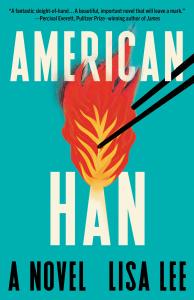
Growing up in the San Francisco Bay Area in the 1980s, Jane Kim and her brother, Kevin, dutifully embodied the model minority myth as their parents demanded: both stellar tennis players and academically gifted, they worked hard to make their parents proud. Jane went on to law school. Kevin came close to becoming a professional tennis player.
But where they started is nowhere near where they have ended up: Jane has stopped going to her law school classes, and Kevin, now a policeman, has become increasingly distant. Their parents, each on their own path toward the elusive American Dream (their mother hell-bent on having the perfect house and the perfect family, their father obsessed with working his way up from one successful business to the next), don’t want to see the family unraveling. When Kevin goes missing, no one recognizes his absence as the warning sign it is until it erupts, forcing them all to come to terms with their past and present selves in a country that isn’t all it promised it would be.
Both deeply serious and wickedly funny, American Han is a profound story about striving and assimilation, difficult love, and family fidelity. A searing portrait that challenges assumptions about the immigrant experience, Lisa Lee’s debut introduces a powerful new voice on the literary landscape.
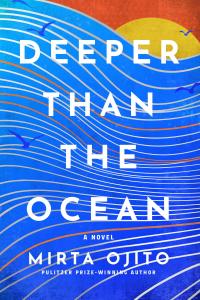
A moving multigenerational novel about the enduring power of a mother’s love, the ripple effect of secrets, and the strength of family bonds from a Pulitzer Prize-winning author.
In 1919 Spain, Catalina Quintana is the eldest daughter in a family of silkworm farmers on the tiny island of La Palma in the remote Canary Islands. Fiercely independent, Catalina dreams of building a life with her childhood love. But when a devastating fire ruins her family’s silkworm farm, she’s forced into a loveless marriage and a journey across the sea to Cuba aboard a doomed ocean liner.
A century later, in 2019, journalist Mara Denis travels to La Palma to cover a modern-day disaster near the island. But the trip becomes personal when her mother asks her to find a long-lost birth certificate. Long haunted by the sea and plagued by dreams of a daughter she’s never had, Mara begins to uncover a hidden family history that centers on Catalina, her great-grandmother who, she soon discovers, is listed among the dead in the infamous Valbanera shipwreck. As Mara follows Catalina’s trail across Spain, Cuba, and Key West, she unearths a story of forbidden love and resilience that echoes through six generations.
Told in a dual narrative that moves seamlessly between past and present, Deeper than the Ocean is a meditation on the strength of women, the enduring power of a mother’s love, and the corrosive hold of family secrets across oceans and time.
This sweeping novel is perfect for fans of Isabel Allende, Julia Alvarez, and Kristin Hannah.
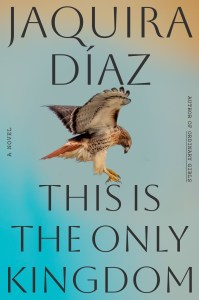
An epic novel of a mother and daughter wrestling with the aftermath of a murder, set against the backdrop of a tightknit, working-class barrio in Puerto Rico—from the Whiting Award-winning author Jaquira Díaz.
When Maricarmen meets Rey el Cantante, beloved small-time Robin Hood and local musician on the rise, she begins to envision a life beyond the tight-knit community of el Caserío, Puerto Rico—beyond cleaning houses, beyond waiting tables, beyond the constant tug of war between the street hustlers and los camarones. But breaking free proves more difficult than she imagined, and she soon finds herself struggling to make a home for herself, for Rey, his young brother Tito, and eventually, their daughter Nena. Until one fateful day changes everything.
Fifteen years later, Maricarmen and Nena find themselves in the middle of a murder investigation as the community that once rallied to support Rey turns against them. Now Nena, a teenager haunted by loss and betrayal and exploring her sexual identity, must learn to fight for herself and her family in a world not always welcoming. For lovers of the Neapolitan novels, This Is the Only Kingdom is an immersive and moving portrait of a family—and a community—torn apart by generational grief, and a powerful love letter to mothers, daughters, and the barrios that make them.
Longlisted for the Center for Fiction First Novel Award
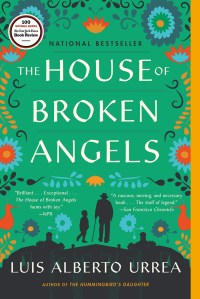
“All we do, mija, is love. Love is the answer. Nothing stops it. Not borders. Not death.”
In his final days, beloved and ailing patriarch Miguel Angel de La Cruz, affectionately called Big Angel, has summoned his entire clan for one last legendary birthday party. But as the party approaches, his mother, nearly one hundred, dies, transforming the weekend into a farewell doubleheader. Among the guests is Big Angel’s half brother, known as Little Angel, who must reckon with the truth that although he shares a father with his siblings, he has not, as a half gringo, shared a life.
Across two bittersweet days in their San Diego neighborhood, the revelers mingle among the palm trees and cacti, celebrating the lives of Big Angel and his mother, and recounting the many inspiring tales that have passed into family lore, the acts both ordinary and heroic that brought these citizens to a fraught and sublime country and allowed them to flourish in the land they have come to call home.
Teeming with brilliance and humor, authentic at every turn, The House of Broken Angels is Luis Alberto Urrea at his best, and cements his reputation as a storyteller of the first rank.
“Epic . . . Rambunctious . . . Highly entertaining.” — New York Times Book Review“Intimate and touching . . . the stuff of legend.” — San Francisco Chronicle“An immensely charming and moving tale.” — Boston GlobeNational Bestseller and National Book Critics Circle Award finalistA New York Times Notable BookOne of the Best Books of the Year from National Public Radio, American Library Association, San Francisco Chronicle, BookPage, Newsday, BuzzFeed, Kirkus, St. Louis Post-Dispatch, Literary Hub
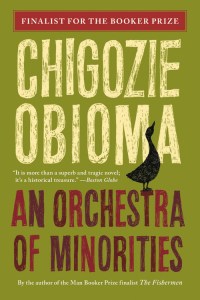
“It is more than a superb and tragic novel; it’s a historical treasure.”-Boston Globe
Set on the outskirts of Umuahia, Nigeria and narrated by a chi, or guardian spirit, An Orchestra of Minorities tells the story of Chinonso, a young poultry farmer whose soul is ignited when he sees a woman attempting to jump from a highway bridge. Horrified by her recklessness, Chinonso joins her on the roadside and hurls two of his prized chickens into the water below to express the severity of such a fall. The woman, Ndali, is stopped her in her tracks.
Bonded by this night on the bridge, Chinonso and Ndali fall in love. But Ndali is from a wealthy family and struggles to imagine a future near a chicken coop. When her family objects to the union because he is uneducated, Chinonso sells most of his possessions to attend a college in Cyprus. But when he arrives he discovers there is no place at the school for him, and that he has been utterly duped by the young Nigerian who has made the arrangements… Penniless, homeless, and furious at a world which continues to relegate him to the sidelines, Chinonso gets further away from his dream, from Ndali and the farm he called home.
Spanning continents, traversing the earth and cosmic spaces, and told by a narrator who has lived for hundreds of years, the novel is a contemporary twist of Homer’s Odyssey. Written in the mythic style of the Igbo literary tradition, Chigozie Obioma weaves a heart-wrenching epic about destiny and determination.
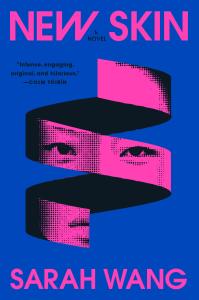
A scalding, darkly humorous debut following an enmeshed mother-daughter duo, both best friends and enemies, and the plastic surgery addiction that warps their lives into a perilous spiral
At twenty-six, Linli Feng is still trying to escape her mother Fanny’s orbit. But after three years of estrangement, just when Linli has been accepted into a prestigious graduate program, she is dragged back by Fanny’s latest medical catastrophe and forced to return home.
For decades, Fanny has been addicted to plastic surgery, getting bargain procedures in the basements of LA’s bootleg beauty industry. Now Fanny’s disfigured face is in dangerous revolt, infected and collapsing yet again from black-market injectables.
But even as Linli wades through the wreck of family finances and juggles her mother’s medical care, Fanny has another secret in store. Fanny has won a spot on America’s Beauty Extreme, a reality television competition in which botched plastic surgery addicts compete for reconstructive surgery as riveted audiences tune in. When Linli attempts to rescue Fanny from the sinister subculture that has already claimed her mother’s face, she must at last confront the corrosive reality of the American Dream that is at the fraught heart of their relationship.
One of Debutiful’s Best Debut Books of the Year (So Far)