4 Books in Honor of Native American Heritage Month
November is Native American Heritage Month. Explore the histories, cultures, and enduring legacies of Indigenous peoples through these 4 essential reads.
“A sobering reassessment of the history of the Great Basin and locates the disruptive and violent influences of colonialism at its center.”—Ned Blackhawk, National Book Award–winning author of The Rediscovery of America
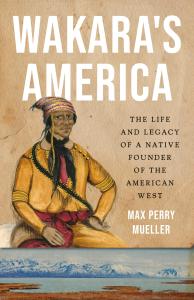
The Native American leader Wakara (ca. 1815–1855) was among the most influential and feared men in the nineteenth-century American West, famed as a fierce warrior, a merciless trader of Indian slaves, and history’s greatest horse thief.
In Wakara’s America, historian Max Perry Mueller illuminates Wakara’s complex and sometimes paradoxical story, revealing a man who both helped build the settler American West and defended Native sovereignty. Wakara was baptized a Mormon and allied with Mormon settlers against other Indians to seize large parts of modern-day Utah. Yet a pan-tribal uprising against the Mormons that now bears Wakara’s name stalled and even temporarily reversed colonial expansion. Through diplomacy and through violence, Wakara oversaw the establishment of settlements, built new trade routes, and helped create the boundaries that still define the region.
Drawing together deep archival research with Native oral histories, archaeology, geology, and ecology, Wakara’s America offers an innovative new vision of the history of the American West with Native people at its center. It serves as a powerful testament to Wakara’s legacy, which endures in his story, in his tribal descendants, and in their stewardship of their ancestral lands today.
Finalist for the 2026 Spur Awards • Shortlisted for the 2026 Plutarch Award
Finalist for the PEN/E.O. Wilson Literary Science Writing Award
“A masterly synthesis of scientific research and personal observation.”—Wall Street Journal
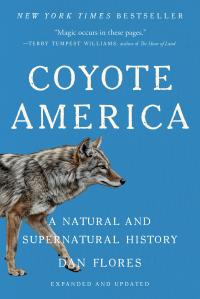
Legends don’t come close to capturing the incredible survival story of the coyote. In the face of centuries of annihilation campaigns employing poisons, gases, helicopters, and bioweapons, coyotes didn’t just survive, they thrived, expanding across North America from Alaska to Florida and New York, and now, as this new edition explores, to South America as well. In the war between humans and coyotes, coyotes have won hands-down.
Coyote America traces both the five-million-year-long biological story of coyotes, as well as their cultural evolution from preeminence in Native American religions to haplessness before the Road Runner. A deeply American tale, the story of the coyote in the American West and then across the entire country is a sort of Manifest Destiny in reverse, with a pioneering hero whose career holds up an uncanny mirror to the successes and failures of American expansionism.
An illuminating biography of an extraordinary animal, Coyote America is one of the great epics of our time.
Winner of the Bancroft Prize in American History
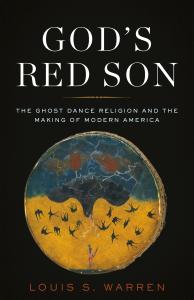
In 1890, on Indian reservations across the West, followers of a new religion danced in circles until they collapsed into trances. In an attempt to suppress this new faith, the US Army killed over two hundred Lakota Sioux at Wounded Knee Creek. In God’s Red Son, historian Louis Warren offers a startling new view of the religion known as the Ghost Dance, from its origins in the visions of a Northern Paiute named Wovoka to the tragedy in South Dakota. To this day, the Ghost Dance remains widely mischaracterized as a primitive and failed effort by Indian militants to resist American conquest and return to traditional ways. In fact, followers of the Ghost Dance sought to thrive in modern America by working for wages, farming the land, and educating their children, tenets that helped the religion endure for decades after Wounded Knee. God’s Red Son powerfully reveals how Ghost Dance teachings helped Indians retain their identity and reshape the modern world.
“An accomplished work of scholarly detection… Swift, moving prose along a twisting storyline lends this brilliant book the feel of a mystery.” —Kirkus (starred)
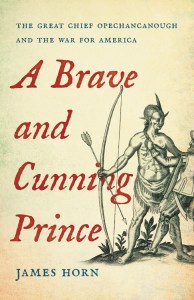
In the mid-sixteenth century, Spanish explorers in the Chesapeake Bay kidnapped an Indian child and took him back to Spain and subsequently to Mexico. The boy converted to Catholicism and after nearly a decade was able to return to his land with a group of Jesuits to establish a mission. Shortly after arriving, he organized a war party that killed them.
In the years that followed, Opechancanough (as the English called him), helped establish the most powerful chiefdom in the mid-Atlantic region. When English settlers founded Virginia in 1607, he fought tirelessly to drive them away, leading to a series of wars that spanned the next forty years—the first Anglo-Indian wars in America— and came close to destroying the colony.
A Brave and Cunning Prince is the first book to chronicle the life of this remarkable chief, exploring his early experiences of European society and his long struggle to save his people from conquest.